Skantos: Difference between revisions
No edit summary |
No edit summary |
||
| Line 54: | Line 54: | ||
=== Other Cultures === | === Other Cultures === | ||
Beyond the widespread Skantoans, several other cultures call Skantos their home; '''Boone''' culture is generally considered to be the least developed and most primitive of all Skantoan cultures, being primarily centred around small coastal fishing villages focused on subsistence hunting. '''Omkha''' culture is generally nomadic and clan-based due to the semi-arid terrain of the region they mainly inhabit, thus they are well known for their usage of working animals and archery, roaming around the southern steppes in 'hordes' to launch raids wherever possible to secure better lives for their own clans, eventually culminating in the rise of the Ikhtalnol empire which unified much of Skantos that allowed the largest of Skantos' modern major cities such as Khurukara to rise to prominence, though most of this region is nowadays populated by Skantoans. '''Praxtins''' are arguably the most isolationist of Skantos' species due to some degree of xenophobia towards outsiders, though regardless they are known for only accepting gifts when they are 'earned', a deep devotion to their religion based around [[Mount Karakoram]], and instilled honesty which has lead to a lack of lying. Alongside its native intelligent life, two species from beyond Skantos have also made the planet their home, with the nation of Anor Londo being inhabited by Humans from the CIS, while much of Senkher was populated by a group of Qu which were stranded after the Battle near Skantos Passage, leading to them developing their own 'spiritual technocratic' culture and society known as [[Uhaten]] which over centuries became the predominant world power and centre of technological advancement on the planet, though after the [[War of the Triple Alliance]] a majority of their population was wiped out aside from a couple thousand survivors which had lost nearly all of their technology and development. | Beyond the widespread Skantoans, several other cultures call Skantos their home; | ||
'''Boone''' culture is generally considered to be the least developed and most primitive of all Skantoan cultures, being primarily centred around small coastal fishing villages focused on subsistence hunting. | |||
'''Omkha''' culture is generally nomadic and clan-based due to the semi-arid terrain of the region they mainly inhabit, thus they are well known for their usage of working animals and archery, roaming around the southern steppes in 'hordes' to launch raids wherever possible to secure better lives for their own clans, eventually culminating in the rise of the Ikhtalnol empire which unified much of Skantos that allowed the largest of Skantos' modern major cities such as Khurukara to rise to prominence, though most of this region is nowadays populated by Skantoans. | |||
'''Praxtins''' are arguably the most isolationist of Skantos' species due to some degree of xenophobia towards outsiders, though regardless they are known for only accepting gifts when they are 'earned', a deep devotion to their religion based around [[Mount Karakoram]], and instilled honesty which has lead to a lack of lying. | |||
Alongside its native intelligent life, two species from beyond Skantos have also made the planet their home, with the nation of Anor Londo being inhabited by Humans from the CIS, while much of Senkher was populated by a group of [[Qu]] which were stranded after the [[Battle near Skantos Passage]], leading to them developing their own 'spiritual technocratic' culture and society known as [[Uhaten]] which over centuries became the predominant world power and centre of technological advancement on the planet, though after the [[War of the Triple Alliance]] a majority of their population was wiped out aside from a couple thousand survivors which had lost nearly all of their technology and development. | |||
== Government and Politics == | == Government and Politics == | ||
Revision as of 11:57, 5 March 2026
| Skantos | |
|---|---|
  | |
| Astrographical Information | |
| System | Skantos System |
| Suns | Gerin |
| Moons | |
| Rings | None |
| Orbital Position | 2 |
| Rotation Period | 27 Hours |
| Orbital Period | 325 Days |
| Distance from Alpha Sol | ~660 Light Years |
| Galaxy | Milky Way |
| Rim | Center Rim |
| Quadrant | Alpha |
| Grid Coordinate | N19 |
| Physical Information | |
| Class | Terrestrial |
| Diameter | 9324 Kilometers |
| Atmosphere | Breathable |
| Climate |
|
| Primary Terrain |
|
| Surface Water | 67% |
| Habitability (%) | 100% |
| Average Surface Temperature (°C) | 8°C |
| Societal Information | |
| Official Title | Sacred Union of Skantos |
| Government Type | Theocratic Parliamentary Confederacy under a Constitutional Elective Monarchy |
| Administrator |
|
| Capital City | Khurukara |
| Demonym | Skantoan |
| Native Species | |
| Immigrated Species | |
| World Languages | |
| Population | ~2.9 Billion |
| Notable Nations | |
| Affiliation | Non-Aligned (De Facto Accord Protectorate) |
| Settled In | Before 34200 BCE |
| Organized In | 536 CE |
Skantos is a medium-sized terrestrial planet and the second planet from Gerin, which is a K-Type Orange-Dwarf situated in the centre of the Skantos System. It is the second largest terrestrial planet in the Skantos System and the only habitable one, having 67% of its surface covered by oceans which surround a collection of four relatively cool and arid continents, with the northern regions of the planet being dominated by tundras, the equator being dominated by grasslands, and the southern regions being dominated by semi-arid steppes. Skantos has developed complex intelligent life such as the Skantoans, the predominant species of the planet which coexist with various other smaller groups.
Skantos is remarkable due to its sheer concentration of Divine Energy, Orgone Energy, and Memoria Energy making it the most spiritual planet that is known to exist, being one of the only planets to be classified as a 'Spiritual Planet'. Despite this, actually getting to Skantos to witness its unusual properties is a treacherous journey as Skantos is located in the heart of the "Skantos Maelstrom", a chaotic nebula full of debris and storms which prevents travel to the planet without carefully charting a course through the Skantos Passage which goes through the south-west of the Maelstrom, making navigation via larger vessels impossible. Another side effect of its location within the Skantos Maelstrom is scanners and telescopes generally have a hard time detecting objects within the Maelstrom, including Skantos itself most of the time. Skantos' spiritual nature appears to be capable of spreading far beyond the planet itself, with religions such as the Theian Native Faith and Ancient Yatan Faith being thought to have originated there, alongside many other religions thought to have originated elsewhere mysteriously being practiced by certain Skantoan cultures.
History
The history of Skantos is shrouded in mystery, though despite this it is known that complex societies and settlements created by the Skantoans had begun first forming on the planet in 26500 BCE, later being joined by the Omkha in 11900 BCE. Some evidence of societies advancing enough to even achieve space travel have been found from this ancient era (primarily around Sycoryo), though clearly any such technologies were either abandoned or the societies which used them collapsed. Skantos was seemingly never colonized or discovered by any spacefaring society until 202 CE due to the Skantos Maelstrom making the planet very difficult to detect, with this eventual discovery being done by a collection of pre-unification Yatan and Theian states such as Asophania[1], Gensokyo, Iujadogia, Macanaland, though some contact had been occurring on beforehand thru the Library of Eden.
While none of the aforementioned polities ever made a very significant presence near the planet, the Commonwealth of Independent Systems is another story as the CIS has over-time established an extensive presence throughout the Skantos System in the form of various hidden facilities and space-stations making use of the Skantos Maelstrom as a easy method of hiding their presence if ever necessary, effectively turning Skantos into an informal protectorate of the CIS and Yatan-Theian Accord as a whole (despite Skantos being unaware of this status, as its inhabitants have never made contact with either of them). Despite their considerable presence, neither the CIS or Accord have interfered extensively on the planet aside from bombing the Uhateni Qu with nuclear weapons to prevent their expansion, causing significant damage,.
Geography
Skantos is divided into 4 major continents situated across its surface, with the 'Saikhan Sea' being defined as a central position from which each of the continents' position is defined, with the largest continent of Saikhan housing steppes, grasslands, and tundras located to the east, the second-largest continent of Senkher primarily housing tundras being situated to the north, the third-largest continent of Karakoram primarily housing volcanic wastelands and arid grasslands being situated to the west, and the smallest continent of Mosonaral also housing tundras being situated to the northeast. Skantos is dominated by a number of water bodies as well, with the Tengis Ocean in the northern hemisphere and the Dalai Ocean in the southern hemisphere divided by the Bay of Jivekh and Bay of Senkherdeer, while the waters between the three largest continents are divided into the Saikhan Sea in the north of the equator and the Ariun Tengis sea in the south. Some further regional definitions also exist to further divide up the continents such as Saikhan often being divided into 'north' and 'south' based on the Occidentine River and Orientine River, though no such definitions are universally agreed upon.
-
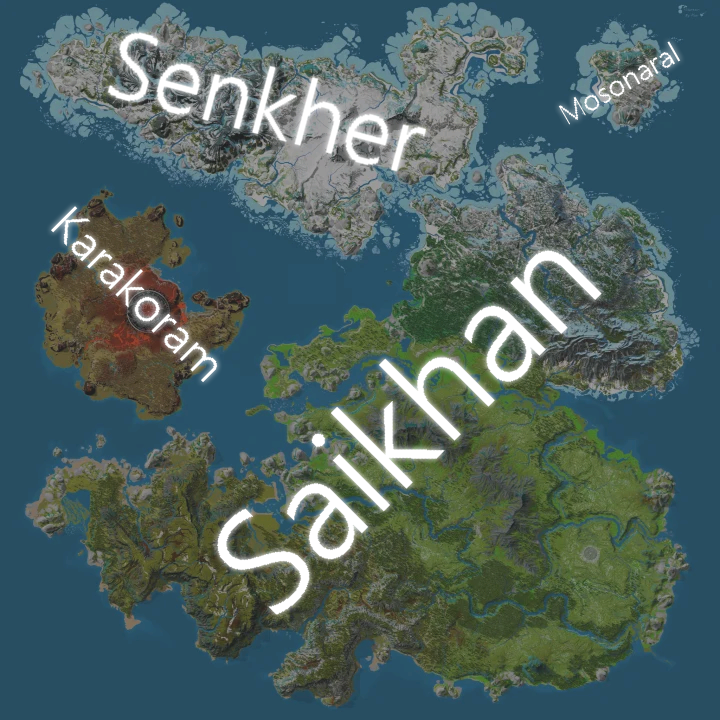
Continents of Skantos
-
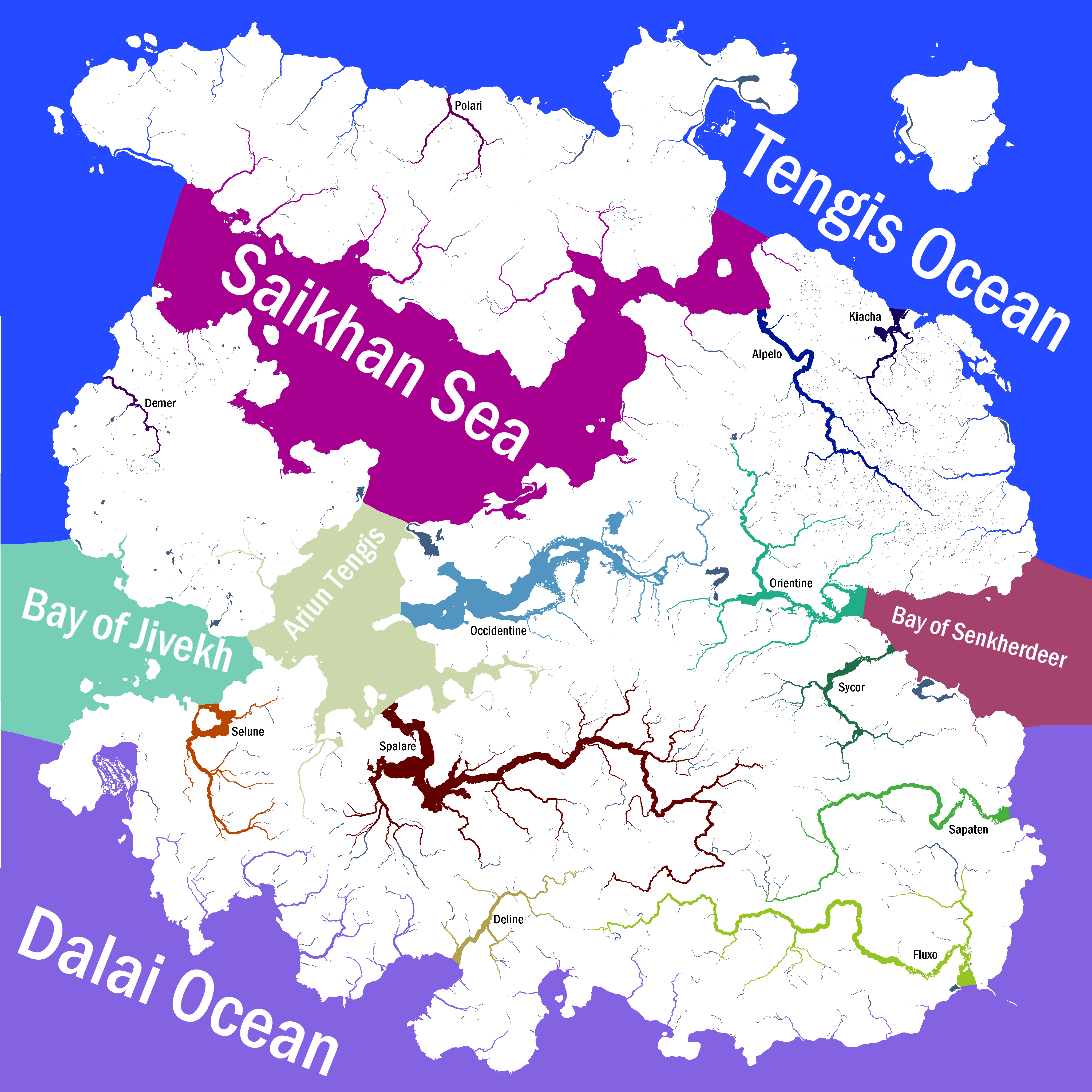
Water Bodies of Skantos


Culture and Demographics

Red - Karakorami
Yellow - Mosonarali
Green - Saikhani
Blue - Senkheri
Skantos is home to a number of different cultural and demographic groups, with the by far most populous species being the Human-like Skantoans which can be found throughout the entirety of the planet. Alongside the Skantoans, many other species also call Skantos home such as the nomadic Omkha mainly found in southwestern Saikhan, the Uhateni Qu nowadays found primarily in western Senkher, the Praxtins found in the nation of Praxtus in Karakoram, the Boone inhabiting several coastlines around the Ariun Tengis Sea, and the Humans in Anor Londo.
Skantoan Cultures
Due to how widespread they are, Skantoans are divided into countless small cultural and linguistic groups that vary greatly from one another, though generally these cultures can be simplified into four 'Cultural Groups' with similar traits amongst one another, with the continents of Karakoram, Mosonaral, Saikhan, and Senkher each featuring their own largely self-contained cultural group aside from much of northern Saikhan, which is generally more similar to Senkher than the rest of Saikhan culturally. Aside from this major exception to the rule, some degree of overlap is inevitable due to the migration of peoples between regions, with occasional small enclaves of 'mismatched' sub-cultures and isolate groups being fairly common.
Karakorami Culture is the most uniform and centralized of all four groups due to the harsh volcanic climate of their home continent and occasional tensions with the neighbouring Praxtins forcing them to advance, leading to higher levels of technological and social progress than in other regions. Karakorami societies are generally centralized with a focus on order and honour, with 'family' serving as the most important social group, though high levels of class-based stratification are also prevalent with significant influence being in the hands of the nobility, which are the traditional heads of the various Karakorami clans and also influential within the Karakorami clergy (a 'class' unique to the Karakorami cultures), though many rulers also implement meritocracy to some extent where possible in order to allow people of lower classes to advance higher up the social ladder. Despite its harsh landscapes, Karakoram is arguably the most resource-rich region of Skantos which has allowed many Karakorami societies to possess very high standards of living. Socially, Karakorami culture is fairly progressive in many issues, with most sub-cultures featuring widespread gender equality and tolerance towards various groups. Other Karakorami beliefs include the burying of cremated ashes, ancestor worship, nuclear families, coming-of-age rituals, and somewhat of a 'warrior culture'.
Mosonarali Culture, much like their continent, is the smallest and most isolationist of all four, encompassing a number of related monastic traditions which make them by far the most spiritual (and magical) of the four groups. Mosonaralians tend to reside within tight-nit communal villages surrounding vast temples governed by elders, while all others are held as equal and granted significant social freedoms when compared to the other groups despite their religious devotion. As a part of Mosonarali Folk Religion, it is encouraged to renounced worldly wealth and prosperity and minimize attachments in order to achieve enlightenment, leading to some tensions with other cultures which do not hold this tenet. Mosonaralians are generally accepting of all forms of love and attraction without any social expectation of hiding such feelings, while children are raised communally. Despite their generally progressive social views, many Skantoan temples segregate based on gender, though this is not necessarily universal, doesn't apply to pilgrims, and isn't very strict as exceptions are fairly common. Additional Mosonarali beliefs include cremation upon death, daily meditation, belief in reincarnation, belief in a 'world of spirits' and a 'world of thought', disavowing all violence aside from self-defence, and providing assistance to those in need wherever possible.
Saikhani Culture is arguably the most diverse (and least religious) out of any of the four cultural groups due to its position as the largest population-wise thanks to occupying most of the temperate and continental regions of Skantos, though their diversity has gradually weakened to some degree following the conquests of the Ikhtalnol, a Omkha empire which managed to unify most of the Saikhani peoples in the late 400s. Saikhani society is very stratified into a class-based system originating from the belief in the importance of 'respect' among one's socioeconomic peers, leading to the nobility beinghighly respected as the 'natural leaders' of society despite their detachment from the issues of 'commoners' due to their wealth, while the 'middle class' also generally has many opportunities despite their comparatively poorer position. Contrasting to the upper minority, most Sakhani individuals can be considered 'peasants' with a remarkably lower standard of living which has lead to issues such as crime being the most prevalent among Saikhani communities. Despite the prevalence of inequality among Saikhani peoples, each individual tends to hold reverence for the nobility and local rulers, with especially the monarchs of the major city of Khurukara being seen as a 'leading figure' throughout much of the Saikhani populated regions, while other regions tend to call their rulers 'Governors' in respect to Khurukara aside from some exceptions such as the monarchic Regialus. Beyond their stratified class divisions, Saikhanians often organize themselves into family-based 'Clans' which are generally synonymous with many of their smaller states. When it comes to social issues, Saikhanians tend to be among the most conservative of the four groups, avidly rejecting many advancements and having very strict social roles among their populace only rivalled by the patriarchal Western Senkheri cultures. Other major Saikhani beliefs include a rural lifestyle (outside of the few major cities), burying upon death, strict social hierarchies, stoicism, polygamy and maintaining tradition.
Senkheri Culture is generally divided into two distinct sub-groups, the 'Western Senkheri' sub-group practiced in Senkher itself, and the younger 'Eastern Senkheri' sub-group practiced in northern Saikhan, with the most notable difference being the higher importance of nobility and hereditary leadership in the West and a higher focus on egalitarianism and leaders being 'respected persons' in the east. The west is much more centralized, finding itself ruled by 'Chiefs' which serve as leaders of larger 'Chiefdoms' (generally 'tribal' polities based around familial kinship networks) with the Chief of Asslemang being the most influential figure within their culture, while the east is much more informal with each local chief (which are moreso 'elected' until death or resignation rather than being hereditary) being generally only held with major importance within their own Chiefdom. The west is culturally much more stratified, having strict patriarchal gender-roles brought forth by their home's harsh climate which lead to the hunting men rising to prominence while women primarily remained as homemakers (though their gender-roles mainly apply to 'social function' rather than how relationships and marriages operate thanks to a degree of individualism), while such a distinction is much less pronounced or even completely nonexistent in the east. Other major Senkheri beliefs include arranged marriages (exclusive to the west), strict social norms and expectations (more prominent in the west), a generally nomadic way of life (generally universal), a high religious reverence via Senkheri Folk Religion (more prominent in the west), and valuing generosity (more prominent in the east).
Other Cultures
Beyond the widespread Skantoans, several other cultures call Skantos their home;
Boone culture is generally considered to be the least developed and most primitive of all Skantoan cultures, being primarily centred around small coastal fishing villages focused on subsistence hunting.
Omkha culture is generally nomadic and clan-based due to the semi-arid terrain of the region they mainly inhabit, thus they are well known for their usage of working animals and archery, roaming around the southern steppes in 'hordes' to launch raids wherever possible to secure better lives for their own clans, eventually culminating in the rise of the Ikhtalnol empire which unified much of Skantos that allowed the largest of Skantos' modern major cities such as Khurukara to rise to prominence, though most of this region is nowadays populated by Skantoans.
Praxtins are arguably the most isolationist of Skantos' species due to some degree of xenophobia towards outsiders, though regardless they are known for only accepting gifts when they are 'earned', a deep devotion to their religion based around Mount Karakoram, and instilled honesty which has lead to a lack of lying.
Alongside its native intelligent life, two species from beyond Skantos have also made the planet their home, with the nation of Anor Londo being inhabited by Humans from the CIS, while much of Senkher was populated by a group of Qu which were stranded after the Battle near Skantos Passage, leading to them developing their own 'spiritual technocratic' culture and society known as Uhaten which over centuries became the predominant world power and centre of technological advancement on the planet, though after the War of the Triple Alliance a majority of their population was wiped out aside from a couple thousand survivors which had lost nearly all of their technology and development.
Government and Politics

The Sacred Union of Skantos is the primary governing body presiding over most of the planet (Aside from Uhaten and Anor Londo), taking the form of a loose theocratic confederacy intended to maintain 'Universal Peace and Harmony' on Skantos. The Sacred Union originates from the 'Sacred Union of Saikhan', a similar polity limited to solely Saikhan which emerged after the Great Skantoan Revolt, waging several conflicts against the increasingly aggressive Uhaten until the War of the Triple Alliance saw the Uhaten (and much of Skantos as a whole) destroyed, prompting them to unify with the other polities on the planet in order to prevent further conflicts between species. As a confederacy, the Sacred Union allows local rulers to maintain nominal control over their territories alongside granting significant self-governance to local communities organized into 'Banners' which themselves are organized into 'Leagues'. Annual meetings are held in the city of Khurukara where all willing member-states and banners convene to collectively organize the whole Sacred Union as a whole when necessary, or to simply foster collaboration between proximate groups. Gradually, the constituent states within the Sacred Union have asserted increasing levels of sovereignty and autonomy from the Union.
Government Structure
Officially, the Sacred Union of Saikhan is a Theocratic Parliamentary Confederacy where most administrative power on the confederal level is concentrated in the 'Spiritual Diet', the Sacred Union's legislature. Administratively, the Sacred Union is incredibly decentralized with local monarchs/presidents having near complete autonomy within their own realms, though despite their autonomy they remain fairly ceremonial in their role due to the simultaneous presence of the Banners and Leagues, which are loose federations of local communities within the lands of the local rulers and beyond them in the vast 'unorganized lands'. Uniquely, the Sacred Union is a theocracy without a sole state religion, with all faiths equally being held to the same significance in government due to them being seen as parts of a 'greater whole'.
As may be expected from such a decentralized entity, the Sacred Union's 'executive government' is generally only ceremonial in order to deal with diplomacy, organizing local rulers/banners, and managing territories with more direct loyalty to themselves. The executive is headed by the four 'High Shamans' (Heads of State and Government) which share executive duties, with each of them representing each of the four major Skantoan cultural groups including the chief of Asslemang (Senkher), the king/queen of Ikhtalnol (Saikhan), the king/queen of Ongansen (Karakoram). and the abbot of Gutons (Mosonaral), as while it may be theoretically possible for other individuals to be elected for this role, it is generally tradition for each of these individuals to be appointed. The High Shamans only have limited powers, and no means to enforce most of them aside from moderating the Spiritual Diet which elects them (for life or until resignation), managing religious/spiritual affairs, and attempting commanding the Sacred Union's military forces known as the 'Armed Banners', though this military often isn't the most effective due to being largely militia-based with only limited numbers of career-trained soldiers and sailors.
Contrast to the weak Executive, the 'Spiritual Diet' which serves as the legislature of the Sacred Union is much more powerful, hosting annual week-long gatherings of local rulers and Jasaghs (leaders of Banners) in Khurukara so that they may discuss issues that affect larger regions or even the whole Sacred Union, making collaboration not only encouraged to keep the Union together but actively beneficial for all within its bounds. Additional duties of the Spiritual Diet is appointing the High Shamans, issuing 'directives' for the High Shaman to accomplish, and appointing Yarguchi (judges) to the Supreme Yarguchi Court in Khurukara.
The 'Yarguchi Courts' serve as the judiciary of the Sacred Union, with each Banner, League, and Member-State appointing their own 'Yarguchi' (Judge) to oversee their own local courts responsible for enforcing laws within their own territories, while especially high-profile court cases are handled by the 'Supreme Yarguchi Court' in Khurukara.
Administrative Divisions
Member-States
The most notable of the Sacred Union's constituents are the 'Member States', consisting of various empires, kingdoms, duchies, republics, and many others. In the eyes of the Member States, they are the 'true' members of the Sacred Union's confederation whose interests matter the most, though in reality their power is limited by the Leagues and Banners.
| Flag | Name | Full Title | Government Type | Capital | Official Languages |
|---|---|---|---|---|---|
 |
Lianguo | Republic of Lianguo | Republic | Lianguoshi | Xitangese |
Sacred Leagues
Sacred Leagues are vast confederacies of Banners spanning across larger regions, either to cover all Banners within a Member State or simply larger areas of the unorganized lands, with the local Jasaghs (leaders of Banners) appointing a 'Menjang' to govern their league.
| Flag | Name | Full Title | Capital | Official Languages |
|---|---|---|---|---|
| tba |
Sacred Banners
Sacred Banners are the most numerous administrative division in the Sacred Union aside from local townships, acting as collections of federated local communities and settlements (which are ruled by Shamans or Mayors) governed by 'Jasaghs' which lead the banners themselves, generally being elected by the communities which compose the Banner.
| Flag | Name | Full Title | Capital | Official Languages |
|---|---|---|---|---|
| tba |
- ↑ (which is theorised to have some connection to the previously mentioned 'space travel' discoveries)
