Theia
| Theia | |
|---|---|
  | |
| Astrographical Information | |
| System |
|
| Suns | |
| Moons | |
| Rings | None |
| Orbital Position | 6 |
| Orbital Period | 1.22 years |
| Galaxy | Milky Way |
| Rim | Center |
| Quadrant | Alpha |
| Grid Coordinate | N19 |
| Physical Information | |
| Class | Terrestrial |
| Diameter | 16436 km |
| Atmosphere | Breathable |
| Climate | Ranges from Desert to Tundra, though mainly temperate |
| Primary Terrain | Temperate forest, tropical grasslands, hot desert, cold desert, taiga |
| Surface Water | 74% |
| Habitability (%) | 100% |
| Average Surface Temperature (°C) | 13°C |
| Fauna | |
| Societal Information | |
| Official Title | Plurinational Union of Theia |
| Government Type | Semi-Confederal Presidential Republic |
| Administrator | President Reed Gallagher |
| Capital City | Alsavaeid City |
| Demonym | Theian |
| Native Species |
|
| Immigrated Species |
|
| World Languages | English (De Facto Lingua Franca) |
| Population | 6.1 billion |
| Major Exports |
|
| Major Industries |
|
| Notable Nations |
|
| Sector | Sol Sector |
| Affiliation | |
| Settled In | 116 CE |
| Organized In | 496 CE |
Theia[1] is the sixth planet from Alpha Sol. It is a terrestrial water world harboring a world ocean that covers 74% of the surface. Theia is the largest, most massive, and fourth-most dense of the terrestrial planets in the Alpha Sol System, and is the second-most populated, behind Yata. It is roughly 26% terrestrial, with the remaining 74% consisting of varyingly sized bodies of water. Situated 1.141 AU from Alpha Sol, the planet takes 1.22 Yatan years to orbit the sun. Theia has two natural satellites - Doluro and Teiro - of which the former is additionally an inhabited water world. Unlike the rest of the planets, Theia and its two moons were a rogue system captured by Alpha Sol in 115 CE, having been ejected from its previous system.
Culture & Demographics
Theia is a very diverse planet, with the three most dominant species being Humans, Keonnans, and Theian Natives. Humans first arrived on the planet after it arrived in the Alpha Sol System in 116 CE, establishing countless nation states throughout the planet which once fully self-sustaining engaged in their own trade, diplomacy, and even warfare amongst one another as their previously Yatan-derived cultures evolved into new Theian forms, with most more metropolitan areas later slowly melding into a more cosmopolitan Theia-wide human culture while allowing the countryside to retain its unique Theian-Yatan flair. The second most populous group on the planet is the Theian Natives, a diverse group of closely related sub-species descended from a faithful, nomadic, yet scientifically advanced culture which had spread across the planet prior to the Theian Cataclysm, later emerging to begin anew. Most Theian Natives reesiding in more populous areas have had their culture begin merging with Human cultures, while more rural or conservative areas such as Kanar have fiercely retained their original culture and devotion to the Theian Native Faith, being visible in several of the Plurinational Union of Theia's 'Republics' instead being officially labeled as 'Archonates' which recognize their patron deities as their true heads of state. The third most populous species on the planet is the Keonnans, as despite only largely inhabiting the region of Kairelopia and the areas that surround it after arriving on the planet at an unknown time centuries before the Cataclysm, the insectoid Keonnans have reproduced rapidly which has lead to the proliferation of their unique matriarchal work-driven way of life which still leaves a impact on the global scene despite its isolated nature beyond trade. Many other less populous species have called Theia their home, most notably the Sarpian Cats of Greater Orientalis, the native Kaphi'si of Kaphi island, and the native Billadakas of Keiria.
Language-wise the by far most dominant language found on Theia is English, having been brought over by the first colonists that landed in Catacoria and Macanaland before spreading out across the planet as it was adopted as a common lingua-franca across the planet by the spread of trade or by more arriving english-speaking colonists. Many regions regardless have their own local languages which survive despite the dominance of English, including both languages used by non-anglophone Humans and the various Native/Keonnan languages, with the most important non-English language being Arabic thanks to its prevalence in the Planetary Capital of Alsavaeid City. Religion-wise Theia is quite diverse, with the three largest religions being Christianity, Islam, and Theian Native Faith behind Atheism, with none of the 3 major religious groups having a clear majority over one another.
History
Theia has seen various major chapters in its history, which are as follows;
The first era was the Pre-Civilisation Eon, which took place from 23093 BCE to 12854 BCE. This period is largely shrouded in mystery, as it predated the establishment of any known organized societies beyond simplistic tribal life among the Theian Natives, who had began spreading across the planet beyond their home along the southern edge of the Gulf of Osnoa.
The second era was the Pre-Elemental Eon, which took place from 12854 BCE to 4401 BCE. After civilisation had developed and gradually advanced into more complex forms, this era became notable for its various nation-states and regional polities that often engaged in warfare and amongst one another. Such conflicts continued until the Great Wars ocurred, devastating much of Theia until the Gods seized control and established the Elemental Lands.
The third era was the Pre-Cataclysm Eon, which took place from 4401 BCE to 276 BCE. Following their ascension into power over the planet, The Eight Gods of Theia divided the planet amongst themselves into eight Elemental Lands, allowing elemental magic to rise into prominence throughout all levels of society. In 601 BCE the Bejriks, a more advanced species native to Theia's Moon of Doluro, made first contact with those on the planet below the, befriending most of the elemental lands due to their at the time fairly similar structure (with the Bejrik deity Varuna becoming the ninth god). Their arrival angered Aireskoi of Kanar though, whom saw the Bejriks as intruders onto their world. This distrust eventually escalated into the Bejrik-Kanar War which began in 456 BCE, with each other land aligning themselves with the Bejrik Order against Kanar. After centuries of warfare, Kanar eventually began to lose until their capital fell in 298 BCE, with the rest of the nation soon afterwards falling in 283 BCE.
The fourth era was the Cataclysm Eon, which took place from 276 BCE to 115 CE. This era was a particularly dark period in Theian History that began with Nihilantis of Aquilae being possessed by Sanmor, turning him against Theia. In order to save the planet, the people of Aquilae (the Iujado) used advanced technologies to eject Theia towards the Alpha Sol System, which they had previously evaluated to be able to sustain life. Theia travelled throughout the interstellar void for many centuries, with the few functioning climate systems slowly breaking down as only subterranean life managed to survive. This era came to a close once Theia had arrived in the Alpha Sol System, where it was captured into orbit between Yata and Mars without much consequences beyond destabilizing Narakam's orbit. Only five of the Elemental Lands (Treimaria, Candra, Lilaciah, Gensokyo, and Kanar) survived the Cataclysm, with only three continuing to practice elemental magic by the time of the Elemental Resurgence during the fifth era.
The fifth era was the Post-Cataclysm Eon, or the Elemental Resurgence Eon, which took place from 115 CE to 239 CE. This era is notable for vast sociopolitical changes as the Theian Natives began to move away from their traditional elemental roots towards the idea of nation-states imported from Yata, from which large numbers of Human settlers began to arrive and establish their own nations. The usage of magic also began to increase following it being unusable during the Cataclysm Eon, though unusually it was only really usable in regions such as Treimaria, Gensokyo and Lilaci'ah. Towards the end of this era the Elemental Resurgence occurred, with the Nine Gods of Theia breing briefly resurrected, culminating in a battle against Miraak, which lead to each of their deaths except Tenno, whom survived by ridding herself of her powers.
The sixth era is the Modern Eon, which began in 239 CE. This era is notable for being when Humans truly became the leading figures of the Theian scene until the natives rebuilt to the point of establishing a more equalised relationship, beginning with a period of largescale conflicts typically involving the Orientalis region. This later evolved into a more peaceful era beyond certain more unstable areas notable for the rise of Polsk (and the CIS), resurgence of Kanar and later on the emergence of the Theian Federation in 435, initiating a slow process of planetary unification until most of the planet was under their rule. The Theian Federation would later additionally take control over the Human homeworld of Yata, reorganizing itself into the Yatan-Theian Federation, which lasted until 495 after the grievances caused by the failure to reinstate democracy in a stable manner after a decade-long period of authoritarianism had eroded the Federation's stability to the point that a series of major crises was enough to cause its collapse, leading to the Yatan-Theian Accord directly integrating its former territories as autonomous planets, leading to the formation of the 'United States of Theia' as the final ruling body responsible for governing a majority of the planet. In 520 CE a broad left-wing coalition was elected into power which renamed the UST into the 'Plurinational Union of Theia' in an attempt to bring Theia's diverse population together.
Geography
Geographic features
Theia is divided into 3 major continents, with the various landmasses within the Jalia Ocean being classified as part of the continent of Jalia, and the Trenton River dividing Theia's mainland into the continent of Panthein in the west and the continent of Deshret in the east. Climate wise, Jalia is nearly entirely tropical, Panthein is mostly Temperate although becomes increasingly cold and frozen-over the further north you go, and Deshret spans from a colder region at its north into becoming much more arid north of its its largely tropical southern area.
Theia is on a smaller level divided into 40 regions largely based on ecological and geographic similarities, spanning from Sassania in the north-west to Altilai in the south-east. Regions may also occasionally be informally grouped together for practical reasons when it comes to referring to larger swaths of land smaller than a continent, with the most prominent of such definitions being 'Greater Orientalis'. Regions are a much more common way to define Theia's geographic boundaries due to how broad the three continents can be.
Most of Theia's surface is made up of countless seas, oceans, rivers, and lakes, of varying importance to the Theian populace, with the sea south of Panthein and Deshret being named the Jalia Ocean, the sea between Panthein and Deshret being named the Kairen Ocean, and the sea north of Panthein and Deshret being named the Balnaara Ocean. The vast majority of Theia's major rivers are actually narrow chasmata - not true rivers - formed by complex convection in Theia's mantle. The main difference is that the chasmata are flooded from both sides by the ocean, are at sea level, and thus flow through tidal forces rather than gravity. This means that Theia, especially in Panthein, is densely connected with wide navigable waterways more akin to canals on Yata. The longest river on Theia is the Magan River in Panthein, barely beating the somewhat shorter yet much wider Savalon River in Deshret.
Theia's larger diameter also means that its surface features are more "extreme" compared to Yata. The highest mountain on the planet is Mount Nislandia in Osania - at 10,897 metres it is just over 2 kilometres taller than Mount Everest on Yata. Theian peaks tend to be more isolated in nature than Yatan peaks, in that Yata's high points are usually situated on a plateau to begin with, whereas Mount Nislandia is almost entirely a standalone mountain.
| Photo | Mountain | Height | Location |
|---|---|---|---|
 |
Mount Nislandia | 10,897m | Osania |
 |
Mount Triton | 10,596m | Karndasoen, Plurinational Union of Theia |
 |
Mount Couloir | 10,038m | Northwest Theian Territories |
 |
Mount Orientalis | 9,910m | Southwest Deshret Territories |
 |
Mount Sapporo | 9,609m | New Sapporo |
 |
Al'Sawayid / Mount Sawayid | 9,223m | Alsavaeid |
 |
San Inde / Mount Inde | 9,052m | Iujadogia |
 |
Mount Vaatun | 9,008m | Arstotzka |
 |
Mount Casteliche | 8,966m | Tritonien |
 |
Mount Azhyyn | 8,881m | Katrelia |
-
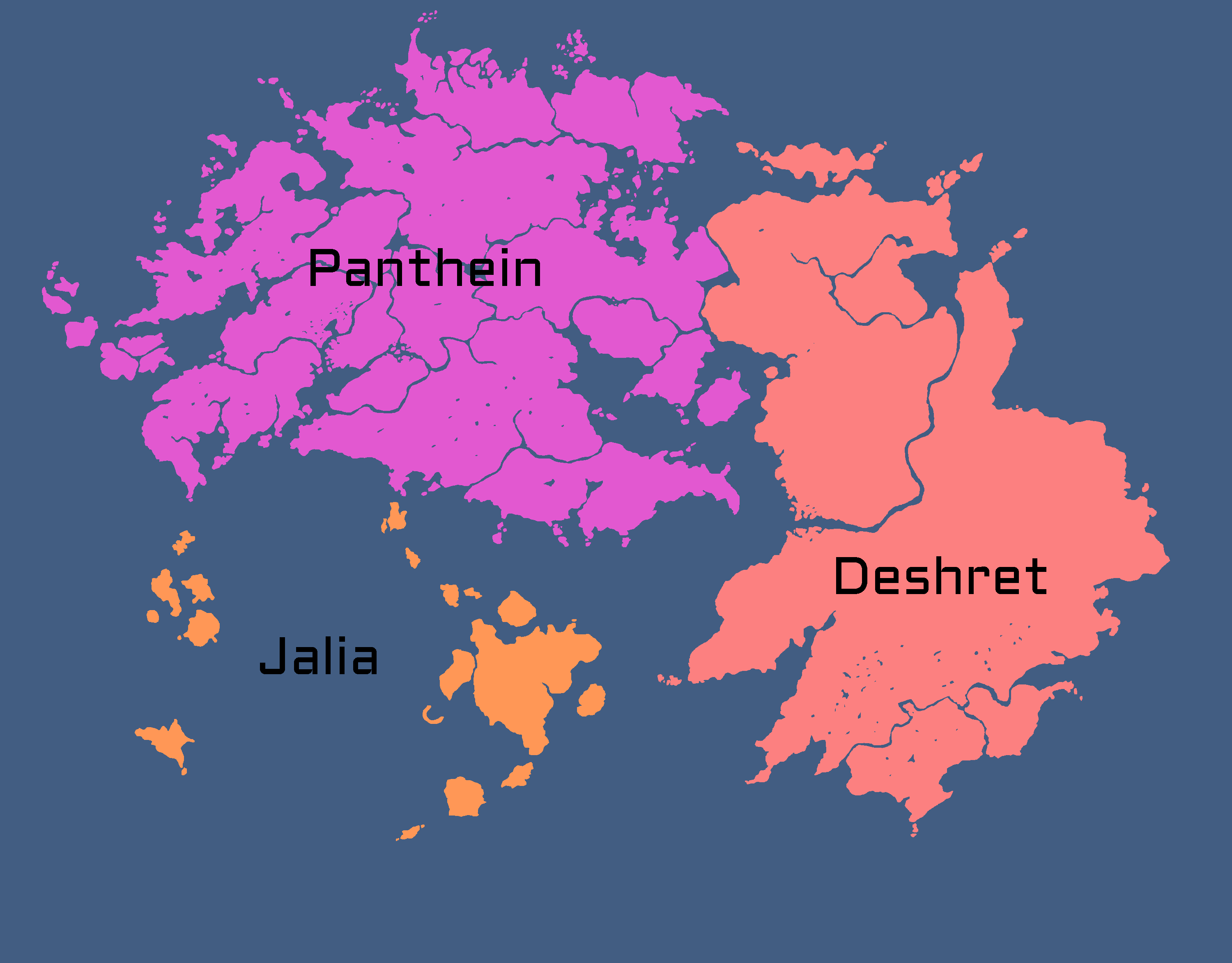
Continents of Theia
-
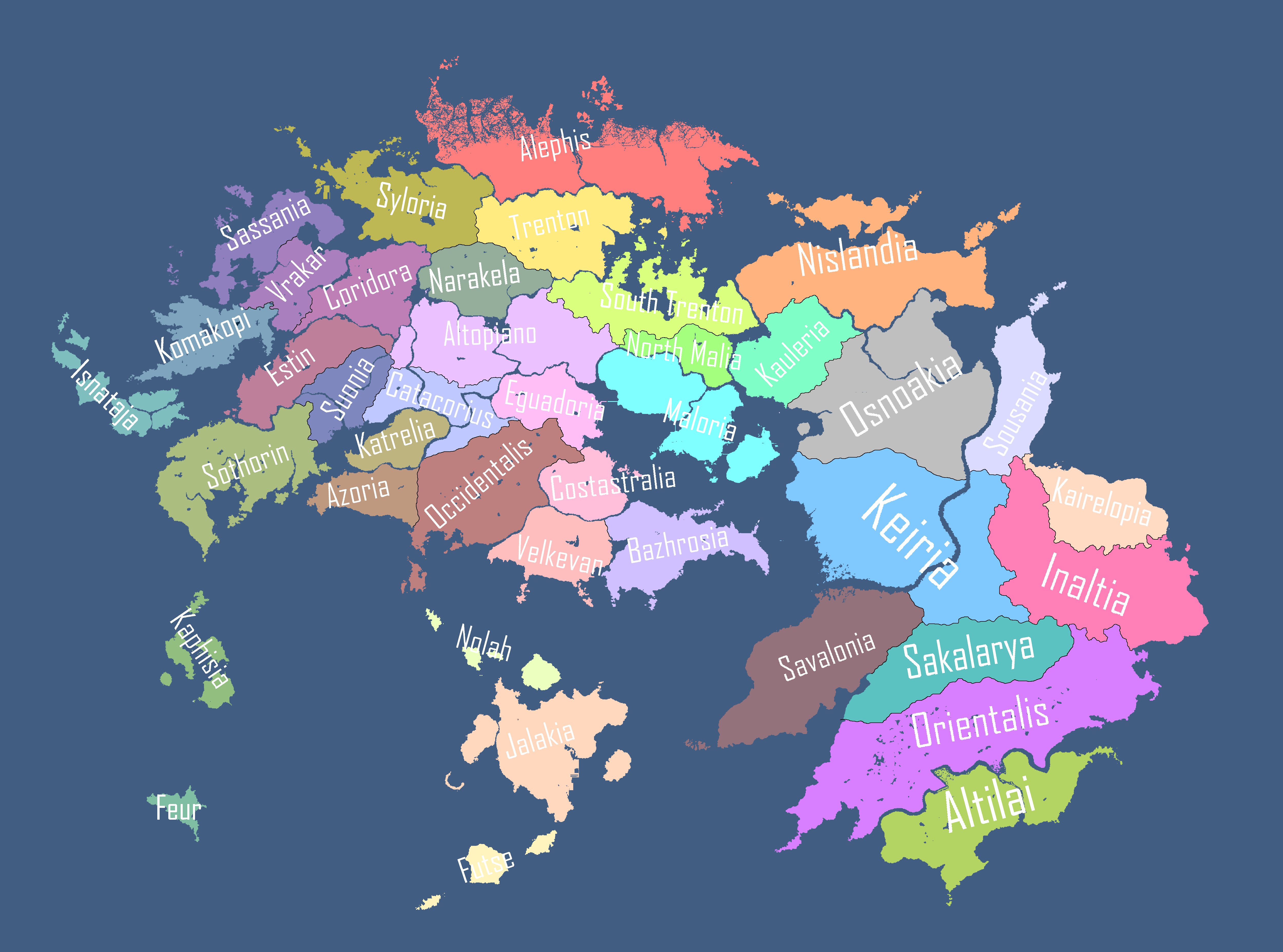
Regions of Theia
-
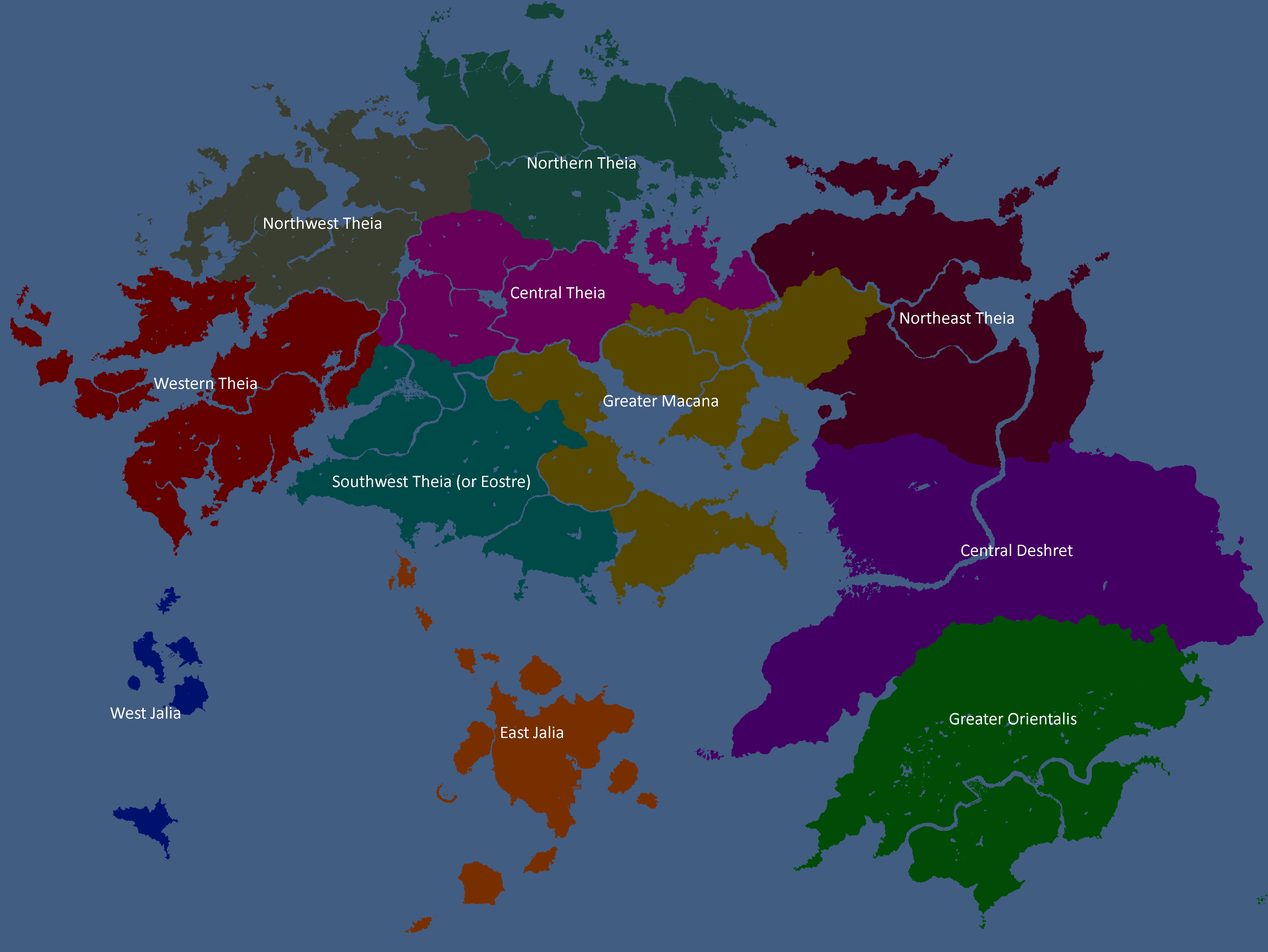
Macroregions of Theia
-
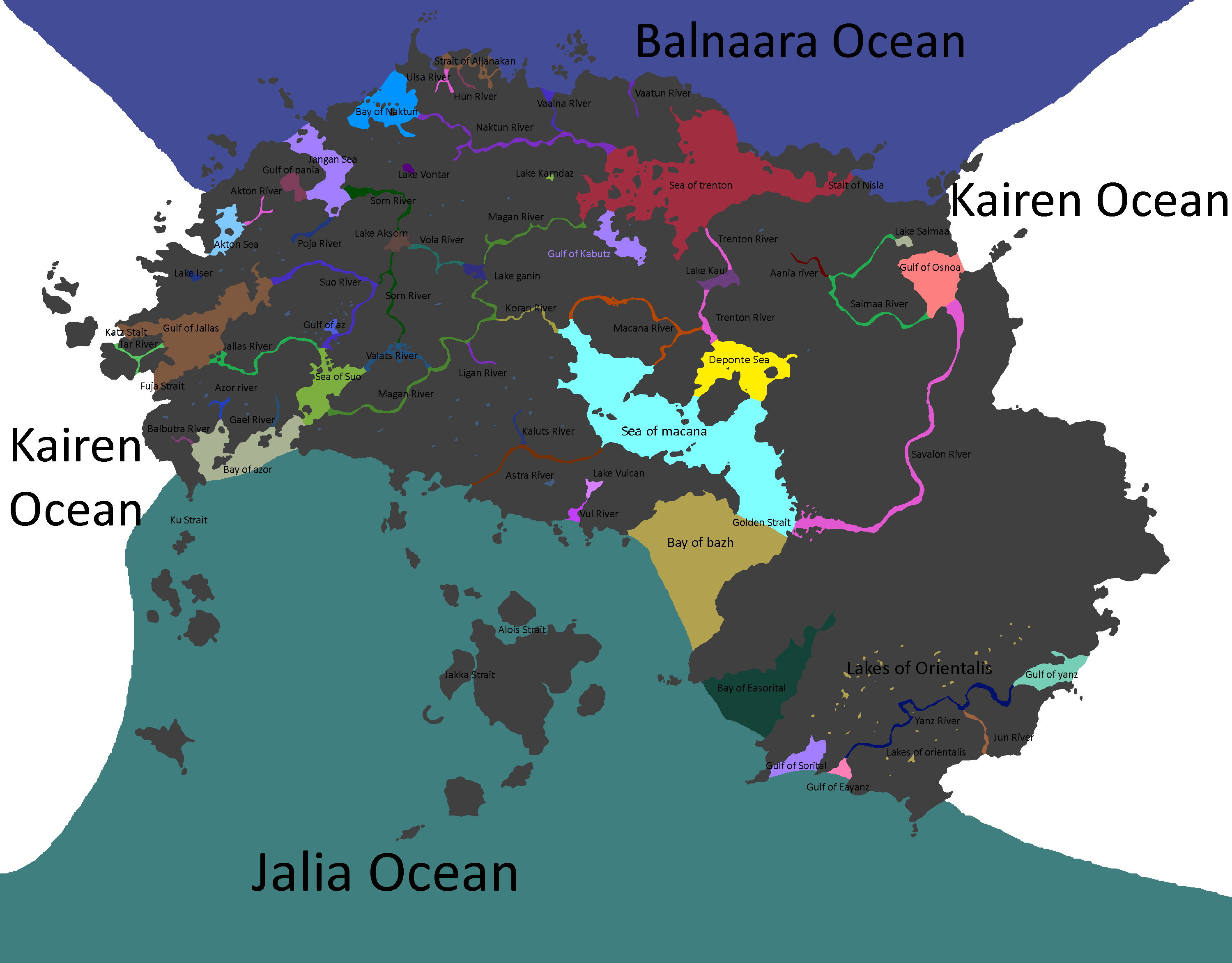
Water Bodies of Theia


Societal Boundaries
Theia is largely divided into two major 'societal regions', with a vast majority of its population residing with 'Organized Theia', which refers to any region on the planet under the reigns of a organized nation-state, with the most populated nation being the Plurinational Union of Theia. Only a fraction of Theia's population resides within the 'Theian Outback', also known as the 'Theian Wilderness'. This area is beyond the administration of any nation-state or institution beyond occasional local governments set up within communities, therefore making the lack of government-provided support a significant difficulty in these regions as technology and societal progress arrives in such locations much slower than elsewhere. Despite their difficulties, many Outback communities still manage to thrive either by chance or by specialising into the sale of illegal products not found elsewhere. Many wilderness communities managed to expand to the point of garnering recognition as states in their own right, such as Anticelenderis and Coutomisto, though most if not all of such instances have been integrated into the Union by now. The Outback rapidly shrank during the 400s, leaving it only still present in very fringe regions while it used to represent up to half of the entire planet, leading to controversy among many former Outbackers wishing to preserve their heritage via means of radical politics such as the anarchistic Free Outback People's Front. In the 540s, a resurfaced effort to 'stabilize the outback' occurred, leading to some degree of conflict as Union defence forces brought Outback under 'protectorate rule' aside from certain remaining sovereign states in order to curtail criminal and insurgent activities.
-
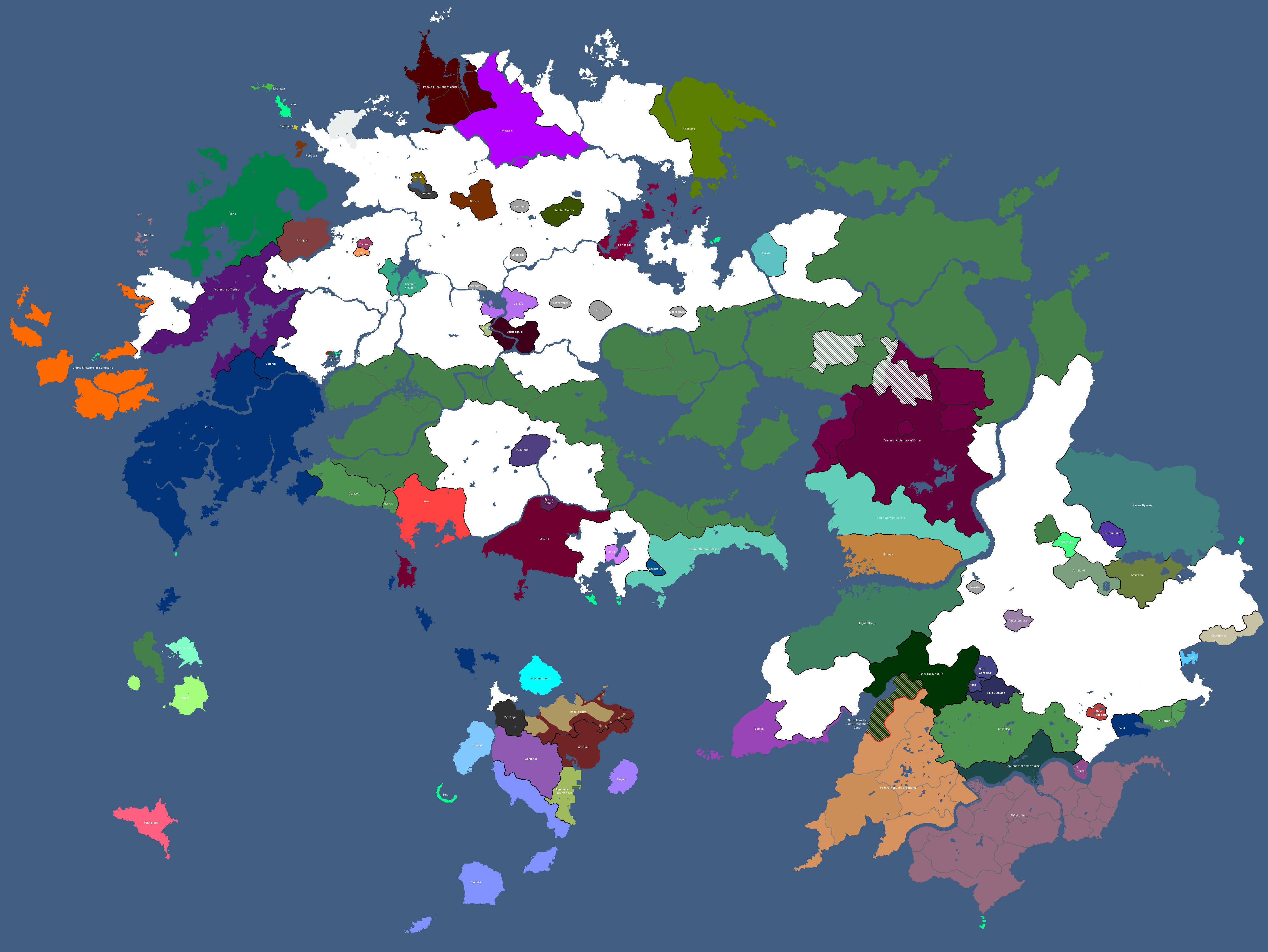
The Nation-States of Civilised Theia, with the Wilderness being marked in gray.

Government and Politics


The 'Plurinational Union of Theia[2]' is Theia's current predominant planetary governing body spanning across a significant majority of its surface, with only certain unorganized fringe regions, remaining sovereign states, and constituents of the Commonwealth of Independent Systems operating beyond Union's governance. The United States of Theia was established following the assassinations, electoral deadlock, and military coup which lead to the collapse of the Yatan-Theian Federation the 'Second Concordance' was signed between the Military Government and the Yatan-Theian Accord, directly integrating all former Federation territories as the new 'Federalized Territories' of the Accord which were promptly organized to grant each inhabited planet extensive self-governance while still instating Accord Law and various collective policies. Managing to successfully retain a unified government despite its many cultural differences, the United States of Theia was established as the ruling body over a majority of the planet, with this 'United States' eventually being renamed into the modern 'Plurinational Union'. Despite unifying, significant portions of Theia remain independent such as Polsk, the Altilai Union, and the Theian Germanic State. Most sovereign states beyond Accord-rule are regardless heavily tied to the government via the League of Theia, a institution that acts as a forum to discuss Theian issues which also grants each Non-Accord sovereign state a observer-representative in the Theian Parliament's House of Nations.
The government of the Union is based in Alsavaeid City, a major metropolis situated in the far north-east of the country along the coast of the Gulf of Osnoa. Much like Yata, Theia's population is spread out enough that it is not the sole urban area, but it regardless holds the position of largest city despite only historically being the nominal diplomatic capital of the planet since the early 400s, being preceded by the Macanese city of Northport. Beyond the larger capitol metropolitan region there are countless other major cities found across the Union which are connected by Theia's robust Highway Network and Railway Network largely managed by 'Deshret Railways' and 'Panthein Railways'.
Government Structure
The government of the Plurinational Union of Theia is divided into 3 major branches, the Executive, Legislative, and Judicial. The Executive Government is headed by the 'President of Theia', a figure responsible for enacting and putting into force the Union's laws as well as representing them on the international stage. The Legislative Government is structurally a bicameral legislature with the 'Theian Parliament' being divided into the 'House of Reviews' and 'House of Nations', with 1 seat per Republic in the 'House of Reviews' totalling at 80 non-partisan representatives and 8 seats per Republic in the 'House of Nations' totalling at 640 partisan representatives, with both houses having a combined total of 720 representatives responsible for proposing and approving new laws. The Judicial Government is largely composed of the 'Theian Court of Justice' responsible for interpreting the law and managing legal situations.
Administratively the Plurinational Union of Theia is divided into 'Republics' as its highest administrative divisions, with each of these Republics being granted significant autonomy which grants them their own constitutions, parliaments, and governments powerful enough to largely run themselves for the most part, with only occasional intervention necessary from the Federal Government. Several Republics with a Theian Native majority (though not all) instead refer to themselves as 'Archonates', viewing their patron deities as their 'true' heads of state in abstentia, while the Keonnan-majority Eastern Baiame refers to itself as a 'Confederation' thanks to the hive-based society. All States regardless of terminology are further sub-divided into provinces and autonomous provinces responsible for managing local regions and in the case of autonomies representing the interests of local ethnolinguistic minorities.
Political Parties
A number of political parties are represented within the Theian Parliament's House of Nations (The House of Reviews is largely non-partisan and dominated by independents), with a vast majority of the 640 representatives belonging to some kind of party. The following is a catalogue of notable member parties;
| Logo | Name | Ideology | Position | Accord Coalition | Status |
|---|---|---|---|---|---|
| Theian Party of Revolutionary Communists |
|
Far-Left | International Worker's Parties | Opposition | |
| Communalist Teijan Party |
|
Far-Left | International Worker's Parties | Fringe Opposition | |
| Free Outback People's Front |
|
Left-Wing to Far-Left | Interplanetary Separatist Alliance | Opposition | |
 |
Communist Party of Theia |
|
Left-Wing to Far-Left | People's Democratic Union | Opposition |
 |
All-Teijan Movement |
|
Left-Wing | People's Democratic Union | Opposition |
| Reformed Technical Party of Theia |
|
Centre-Left to Left-Wing | Non-Partisan Development Coalition | Opposition | |
| Progressive Development Front |
|
Centre-Left | People's Democratic Union | Opposition | |
| Democratic Labour Party of Theia |
|
Centre-Left | People's Democratic Union | Opposition | |
| Independent Parties Association of Theia | Big Tent | Syncretic | Non-Partisan Development Coalition | Opposition | |
 |
National Labour Party of Theia | National Bolshevism | Syncretic | International Worker's Parties | Fringe Opposition |
 |
Liberal Democratic Party of Theia |
|
Centre | Liberal Democratic Alliance | Government |
| National Sovereignty Front of Theia |
|
Centre-Right | Interplanetary Separatist Alliance | Fringe Opposition | |
 |
Freedom and Democracy Party |
|
Centre-Right to Right-Wing | Liberal Democratic Alliance | Government |
| Theian Frontier Party | Libertarian Conservatism | Right-Wing | Patriots of Tradition | Opposition | |
| Adytian Sovereignty Party |
|
Right-Wing | Interplanetary Separatist Alliance | Fringe Opposition | |
 |
United Conservative Party of Theia |
|
Right-Wing | Patriots of Tradition | Opposition |
 |
National Patriot Party of Theia |
|
Right-Wing to Far-Right | Patriots of Tradition | Opposition |
| People's National Front in Theia | Trophia Thought | Far-Right (Denied) | National Vitality Front | Fringe Opposition | |
 |
Islamic Ummah Front of Theia | Islamic Theocracy | Far-Right | Patriots of Tradition | Fringe Opposition |
| Brotherhood Party |
|
Far-Right | National Vitality Front | Fringe Opposition | |
| Teijan Party for the Great Crusade | Theian-Crusaderism | Far-Right (Denied) | Interplanetary Separatist Alliance | Fringe Opposition |
Economy
The economy of the Plurinational Union of Theia can be best described as a form of regulated capitalism where the free-market is allowed to operate yet the government is capable of intervening when necessary in order to prevent monopolies, ensure quality, ensure worker's rights/safety, and keep prices low. Taxation is the primary source of income for the government, which utilises said funds to provide its people with universal basic income, universal healthcare, welfare subsidies, and various other amenities.
Republics of Theia
The Union is composed of several self-governing republics with significant autonomy, taking the place of second most decentralized planetary government within the entire Accord behind Yata, largely allowing each of its constituents to manage their own affairs. Many other planetary governments swear loyalty as 'dominions' of the Republics of Theia, though they are legally their own entities. Further on, each Republic is composed of 'provinces' and 'autonomous provinces', though how autonomous each of these are also being up to the Republic.
| Flag | Name | Full Title | Capital | Official Languages |
|---|---|---|---|---|
 |
Adytium | Republic of Adytium/Ämärangia | Adytia |
|
 |
Aethra | Archonate of Aethra | Paraleis City | Aethran |
 |
Akerchia | Republic of Akerchia | Kirk City | English |
 |
Akkiam | Republic of Akkiam | Akkiam-Ville | French |
 |
Albelarya | Republic of Albelarya | Bella Orienta | Italian, English |
 |
Alsavaeid | Republic of Alsavaeid-Illa Sousania | Alsavaeid City |
|
 |
Altilai | Republic of Altilai | Ciudad Gris |
|
 |
Androidia | Republic of Androidia | Anderus | English |
 |
Anticelenderis | Republic of Anticelenderis | Anticelenderis (City) | Central Baiamean |
 |
Arcoradia | Republic of Arcoradia | Arcoville | English |
 |
Arstotzka | Republic of Arstotzka | Paradinza | German |
 |
Asaskania | Republic of Asaskania | Saskanovich | Trentish |
 |
Avanarthka | Republic of Avanarthka-New Yetia | Zento City |
|
 |
Baitang | Republic of Baitang | Zhonfeng |
|
 |
Belorsk[3] | Republic of Belorsk | Novaje Hrosna | Belarusian |
 |
Bialwea | Republic of Bialwea | Pau Moujhane | Biawen Kanaran |
 |
Chatou | Republic of Chatou | Chatou City | French |
 |
Cipherna | Republic of Cipherna | Catacor | English |
 |
Coconutia | Republic of Coconutia | Coconut City | English |
 |
Coutomisto | Republic of Coutomisto | Costadinalti | Portuguese |
 |
Daklagh | Republic of Daklagh | Castle Hill |
|
 |
Dazhyyn | Republic of Dazhyyn | Dwrozkikh | Dazhyyn Eostrean |
 |
Dina | Republic of Dina | Dinastadt | German |
 |
Dunavodia | Republic of Dunavodia | Dunav | Serbo-Croatian |
 |
Eastern Baiame | Confederation of Eastern Baiame | Stalgasin |
|
 |
East Trentonia | Republic of East Trentonia | Trentigrad | Russian, Trentish |
 |
Ekkosta | Republic of Ekkosta | Ekko | English, Inuktitut |
 |
Eliasia | Republic of Eliasia | Eliasia City | English |
 |
Equador-Hayaste | Republic of Equador-Hayaste | Equador City |
|
 |
Essoritalia | Republic of Essoritalia | Floppascus | Arabic |
 |
Euskara Berria | Republic of Euskara Berria | Nueva-Vitoria-Gasteiz-Berria | Basque |
 |
Exakarsia | Republic of Exakarsia | Karsis Antoloi | Trentish |
 |
Feur Island | Republic of Feur Island | Feur City | Korean |
 |
Foriunla | Republic of Foriunla | Ooglaboo | Italian |
 |
Futuroespacio | Republic of Futuroespacio | Futurespace | Spanish |
 |
Gapa'hia | Republic of Gapa'hia | Gapa'hia City | English |
 |
Geldve | Republic of Geldve | Magansville | Portuguese |
 |
Gensokyo | Archonate of Gensokyo | Sanctorio |
|
 |
Gorgonia | Republic of Gorgonia | Gorgophone |
|
 |
Isernotaria | Republic of Isernotaria | Puktoktud | English |
 |
Iujadogia | Republic of Iujadogia | Trentonia | Iujadogian |
 |
Jaslandia | Republic of Jaslandia | Jastown |
|
 |
Kajidiya | Republic of Kajidiya | Mina'jadid |
|
 |
Kanar | Archonate of Kanar | Aqkhueln |
|
 |
Kaphi | Republic of Kaphi | Levsara |
|
 |
Karndasøen | Republic of Karndasøen | Jojopia | Danish |
 |
Katrelia | Republic of Katrelia | Theia City | Russian |
 |
Könbatyşçir | Republic of Könbatyşçir | Najm Aljabal | Tatar |
 |
Kisvrik | Republic of Kisvrik | Xatuhlhuan | English, Kisvrik Baiamean |
 |
Koranistan | Republic of Koranistan | Koran City | Kazakh |
 |
Lagomonte | Republic of Lagomonte | Lagomonte City | Spanish, Turkish |
 |
Lainupka | Republic of Lainupka | Lainupka City | Macedonian |
 |
Ligania | Republic of Ligania | Likasville | English |
 |
Lilaciah | Republic of Lilaciah | Lilac City |
|
 |
Lutaria | Republic of Lutaria | Lemongrad |
|
 |
Macanaland | Republic of Macanaland | Northport | English |
 |
Mikono | Republic of Mikono | Mtajikono | Swahili |
 |
Mysthaja | Republic of Mysthaja | Klegger | Mysthajan Narakamian |
 |
New Finland | Republic of New Finland | New Helsinki | Finnish |
 |
New Michigan | Republic of New Michigan | Frost Flake Town | English |
 |
New Missisippi | Republic of New Missisippi | Cheeto Hill | English |
 |
New Sapporo | Republic of New Sapporo | New Sapporo City | Japanese |
 |
Op'fui | Republic of Op'fui | Oppanui |
|
 |
Oriento | Republic of Oriento | Orientoshiti | Japanese |
 |
Osania | Republic of Osania | Osnoaani |
|
|
Outback Protectorates* | Outback Protectorates | Alsavaeid City (De Facto) | Various |
 |
Pasagre | Republic of Pasagre | Pilseta | Latvian |
 |
Polsk[4] | Federation of Polsk | New Warsaw |
|
 |
Portosene | Republic of Portosene | Sapphos | Trentish |
 |
Primeveria | Republic of Primeveria | San Primeva | English, Portuguese |
 |
Reagruparse | Republic of Reagruparse | Reagruparse | Spanish |
 |
Rebecca | Republic of Rebecca | Katt | English |
 |
Republia | Republic of Republia | Lesrenadi | English |
 |
Sacaeia | Republic of Sacaeia | Redcoast | English |
 |
Saimare | Republic of Saimare | Saimar | French |
 |
Sakalyariya | Republic of Sakalyariya | Cascipivera |
|
 |
Salina | Republic of Salina | Salina City | English |
 |
Sandland | Republic of Sandland | Sandcity |
|
 |
Savalonia | Republic of Savalonia | Keldryk | Hebrew |
 |
Sedeia | Republic of Sedeia | Sedeia City | Trentish |
 |
Senkai | Republic of Erimosia | New Senkai City |
|
 |
Senkesia | Republic of Senkesia | Kabutz City | Trentish |
 |
Sothro | Republic of Sothro | Sothro City |
|
 |
Sousania | Republic of Sousania | Springfield | English |
 |
South Inaltia | Republic of South Inaltia | TFEA City |
|
 |
South Orientalis | Republic of South Orientalis | Yanz City |
|
 |
Sud-de-Cas | Republic of Sud-De-Cas | Cascis |
|
 |
Sumera | Republic of Sumera | Sumera City | Sumeran |
 |
Suonischland | Republic of Suonischland | Trockenügel | German |
 |
Susçir-Avestierra | Republic of Susçir-Avestierra | Sogschela |
|
 |
Toraxia | Republic of Toraxia | Eione City | English |
 |
Tritonien | Archonate of Tritonien | Alephitis | Alephian |
 |
Tubbo | Republic of Tubbo | Tubbo City | English |
 |
Uchtadaryo | Republic of Uchtadaryo | Uchtadaryo City | Uzbek |
 |
Uhlangia | Republic of Uhlangia | Ungala |
|
 |
Uttar Baayame | Republic of Uttar Baayame | Tanezruft |
|
 |
Valats | Republic of Valats | Valatsorn City | Russian |
 |
Vulcan | Republic of Vulcan | Lake Vulcan City | Dutch |
 |
West Altilai | Republic of West Altilai | Bingbong |
|
 |
West Malia | Republic of West Malia | Furenze | English |
 |
Whoania | Republic of Whoania | Whoania City |
|
 |
Yakamotomoto | Republic of Yakamotomoto | Tsubetsu | Japanese |
 |
Yamato | Republic of Yamato | Minshu | Japanese |
 |
Yanz | Republic of the Yanz | Madinat Fluba |
|
 |
Yosemia | Republic of Yosemia | Special-City-1 | English |
Plurinational-Union Observer-Republics
Alongside the fully integrated members of the Union, select nations have opted to remain separate states while retaining an 'observer status' where they are allowed to participate within the Parliament without voting-rights and participate in some (or all) institutions without fully joining the Plurinational Union of Theia.
| Flag | Name | Full Title | Capital | Official Languages |
|---|---|---|---|---|
 |
Al-Safran | Arab Federation of Al-Safran | Habdalla City | Arabic |
 |
Ena | Ena Republic | Ena City |
|
 |
Zina | Greater Zina Realm | Zina Theia | Frisian |
Outback Protectorates
Starting in 532, the Plurinational Union has embarked on a campaign to ensure 'stability' within the unorganized Theian Outback, establishing a series of 'Protectorates' responsible for rooting out any active armed and criminal groups.
| Flag | Name | Full Title | (De Facto) Capital | Official Languages |
|---|---|---|---|---|
|
Alephian Territories | Protectorate of the Alephian Territories | Alephitis |
|
|
Jalakian Territories | Protectorate of the Jalakian Territories | Klegger | Mysthajan Narakamian |
|
Komakopian Territories | Protectorate of the Komakopian Territories | Puktoktud |
|
|
Nislandian Territories | Protectorate of the Nislandian Territories | Saimaansuu | Finnish |
|
Northwest Theian Territories | Protectorate of the Northwest Theian Territories | Coconut City |
|
|
Southwest Deshreti Territories | Protectorate of the Southwest Deshreti Territories | Anticelenderis City |
|
|
Sylorian Territories | Protectorate of the Sylorian Territories | Akkiam-Ville | French |
|
Vulian Territories | Protectorate of the Vulian Territories | Lake Vulcan City | Dutch |
|
Yanzian Territories | Protectorate of the Yanzian Territories | Yanz City |
|
| Member States | Commonwealth of Independent Systems • Danor Republic • Dual Republic of Qel and Xya • Federalized Territories* • Technate of Altair |
|---|---|
| Sectoral Governments | |
| Planetary Governments | Altair-3 • Doluro • Glasia A • Interplanetary Network • Luna • Mars • Mercury • Narakam • Narralt • Qel • Saleuyth B • Skurial • Teiro • Theia • Venus • Xya • Yata |
| Accord Organizations | Accord Paranormal Corps • Intracom Network • United Occult Initiative |
| Accord Military | Accord Ark-Ship • Accord Assault Craft - XAC150 • Advanced Escort Carrier • Barracuda-Class Cruiser • Gollus-Class Battlecruiser • Lavul-class Dreadnought • Narakamian Magma-Class Mothership • Polaris-Class Dreadnought • Thorium-Class Frigate • Unity Station |
