Skantos: Difference between revisions
No edit summary |
No edit summary |
||
| Line 115: | Line 115: | ||
|[[File:senkherflag.png|112x112px|left|frameless]] | |[[File:senkherflag.png|112x112px|left|frameless]] | ||
|[[Senkher]] | |[[Senkher]] | ||
| | |Senkheri Confederacy | ||
| | |Tribal Monarchy | ||
|[[Agnaqiul Sitikkut]] | |[[Agnaqiul Sitikkut]] | ||
|[[Senkherip Kitaani]] | |[[Senkherip Kitaani]] | ||
Revision as of 16:54, 14 April 2026
| Skantos | |
|---|---|
  | |
| Astrographical Information | |
| System | Skantos System |
| Suns | Gerin |
| Moons | |
| Rings | None |
| Orbital Position | 2 |
| Rotation Period | 27 Hours |
| Orbital Period | 325 Days |
| Galaxy | Milky Way |
| Rim | Center Rim |
| Quadrant | Alpha |
| Grid Coordinate | N19 |
| Physical Information | |
| Class | Terrestrial |
| Diameter | 9324 Kilometers |
| Atmosphere | Breathable |
| Climate |
|
| Primary Terrain |
|
| Surface Water | 67% |
| Habitability (%) | 100% |
| Average Surface Temperature (°C) | 8°C |
| Societal Information | |
| Official Title | Sacred Union of Skantos |
| Government Type | Parliamentary Confederacy |
| Administrator |
|
| Capital City | Lianguoshi |
| Demonym | Skantoan |
| Native Species | |
| Immigrated Species | |
| World Languages | |
| Population | ~1.2 Billion |
| Affiliation | Sacred Union of Skantos (Unaligned) (De Facto Accord Protectorate) |
| Settled In | Before 164100 BCE |
| Organized In | 536 CE |
Skantos is a medium-sized terrestrial planet and the second planet from Gerin, a K-Type Orange-Dwarf situated in the centre of the Skantos System, while Skantos itself is orbited by two moons, the much larger spherical Sar and the asteroid-sized Jirok. It is the second largest terrestrial planet in the Skantos System and the only habitable one, having 67% of its surface covered by oceans which surround a collection of four relatively cool and arid continents, with the northern regions of the planet being dominated by tundras, the equator being dominated by grasslands, and the southern regions being dominated by semi-arid steppes. Skantos has developed complex intelligent life such as the Skantoans, the predominant species of the planet which coexist with various other smaller groups. Skantos is divided into a number of independent nations of which the four 'paramount nations' which encompass a vast majority of its landmass are associated with the 'Sacred Union', a loose planet-wide alliance designed to maintain peace and natural balance after recent instability.
Skantos is unique for its unnaturally immense concentration of Orgone Energy[1] making it among the most spiritual and magically-prone planet that is known to exist, being one of the only planets to be classified as a 'Spiritual Planet'. Despite this, actually getting to Skantos to witness its unusual properties is a treacherous journey as Skantos is located in the heart of the "Skantos Maelstrom", a chaotic nebula full of debris and storms which prevents travel to the planet without carefully charting a course through the Skantos Passage which goes through the south-west of the Maelstrom, making navigation via larger vessels impossible. Another side effect of its location within the Skantos Maelstrom is scanners and telescopes generally have a hard time detecting objects within the Maelstrom, including Skantos itself most of the time. Skantos' spiritual nature appears to be capable of spreading far beyond the planet itself, with religions such as the Theian Native Faith and Ancient Yatan Faith being thought to have originated there, alongside many other religions thought to have originated elsewhere mysteriously being practiced by certain Skantoan cultures.
Culture, Society and Demographics
Skantos as a whole is significantly less advanced than Human cultures despite possessing organized societies for much longer, only possessing extremely limited industrial capabilities with a vast majority of the planet being in a decentralized feudal/tribal state where local communities only nominally loyal to higher governing authorities. Due to their naturally decentralized nature, most Skantoan communities and regions which share a wider cultural group are in some form confederated into wider governmental institutions, often leading to a majority of the peoples of Karakoram, Mosonaral, Saikhan, and (western/eastern) Senkher being depicted as 'unified' or homogenous societies, though in reality each of these four major civilizations is incredibly decentralized in varying degrees, with Karakoram arguably being the most centralized due to having a more widely recognized monarchy, Mosonaral being completely decentralized in an almost anarchic manner, Saikhan being a loose feudal collection of provinces and protectorates only nominally loyal to their "shared monarchy", and Senkher more-so being a collection of loose tribes of which many don't recognise the authority of their high Chief. As such, the often uniform colours on a map depicting Skantos as divided into four major powers should not be interpreted as meaning that they are unified nation-states, as to this day each individual settlement (and especially each individual region) is effectively its own 'nation' in all but name.
Culturally, the four major cultural groups present in the four largest 'civilizations' differ from each other significantly. Due to Karakoram's harsh volcanic climate and the presence of competitors, the locals were forced to advance to higher levels than in much of the rest of Skantos which lead to the development of many centralized communities centred around family and social class which lead to the development of a surprisingly high living standard for such a harsh environment where agriculture is often difficult. Mosonaral's isolated and tightly populated position lead to it naturally maintaining a lifestyle of tight-nit communal villages primarily headed by religious figures, with the high level of trust in society leading to the development of a significant focus towards freedom and individual liberty despite the importance of religion. Saikhan's vast arable lands and river systems lead to the development of highly structured societies primarily dominated by major feudal lords and landowners nominally loyal to a shared ceremonial 'Saikhani monarchy' where they serve as governors and maintainers of social tradition, making the lives of the poorer majority of Saikhanians arguably worse than that of the other major cultural groups due to high degrees of social stratification and highly conservative attitudes preventing major progress which has instilled a kind of 'stoicist' mentality. Senkheri culture is divided into two sub-groups where the developed 'west' possesses strict social roles and a clearer hierarchy while the 'east' is largely egalitarian and decentralized with a focus on respect, though due to sharing a harsh tundra climate they share many common traits thanks to both practicing similar forms of nomadism.
Alongside the four major civilizations of the Skantoans, the other less populous species of Skantos also possess their own cultures such as the subsistence-hunting Boone, nomadic Omkha mounted-archers, the isolationist and advanced Praxtins, the Crystal Ponies of the isolated Crystal Empire, the mysterious shapeshifting Theyvin of Gleann Ganaim, and the sole "alien" settlements of Anor Londo and Uhaten which developed after the Battle near Skantos Passage (though the latter has largely dissipated due to competition with Skantoans). Many other Skantoan cultures exist as well, with the Qankuli being a formerly Senkheri culture which developed a centralized monarchy which was maintained by brutality, with the Kasa-Kyolmik splitting off of them to embrace a 'less repressive' theocratic model, while to the south the Sideritum and Taaraa-Patitah cultures developed distinct religious beliefs from the wider Saikhani culture which lead to their separation, while Phillealand and Skelden simply never had enough contract with the rest of wider Saikhani culture to integrate into the group.
Geography
Skantos is divided into 4 major continents situated across its surface, with the 'Saikhan Sea' being defined as a central position from which each of the continents' position is defined, with the largest continent of Saikhan housing steppes, grasslands, and tundras located to the east, the second-largest continent of Senkher primarily housing tundras being situated to the north, the third-largest continent of Karakoram primarily housing volcanic wastelands and arid grasslands being situated to the west, and the smallest continent of Mosonaral also housing tundras being situated to the northeast. Skantos is dominated by a number of water bodies as well, with the Tengis Ocean in the northern hemisphere and the Dalai Ocean in the southern hemisphere divided by the Bay of Jivekh and Bay of Senkherdeer, while the waters between the three largest continents are divided into the Saikhan Sea in the north of the equator and the Ariun Tengis sea in the south. Some further regional definitions also exist to further divide up the continents such as Saikhan often being divided into 'north' and 'south' based on the Occidentine River and Orientine River, though no such definitions are universally agreed upon.
-
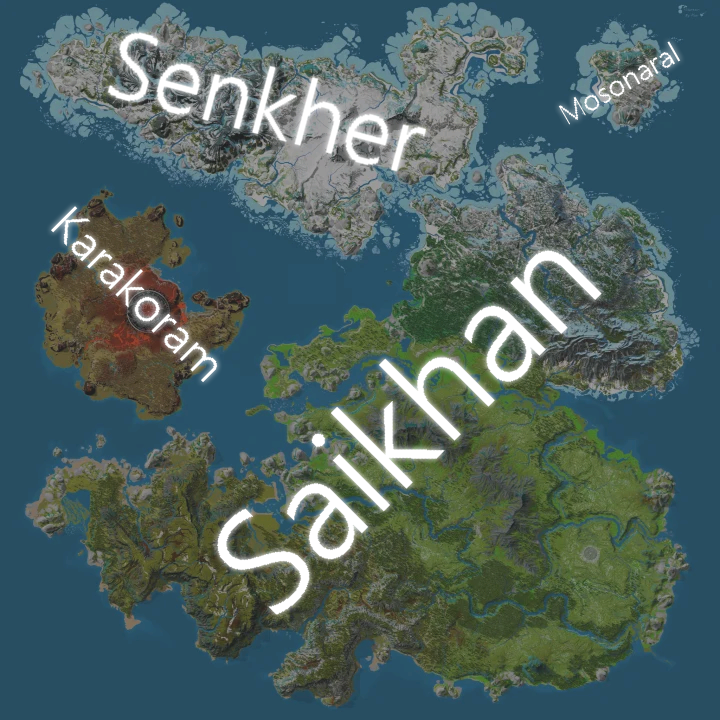
Continents of Skantos
-
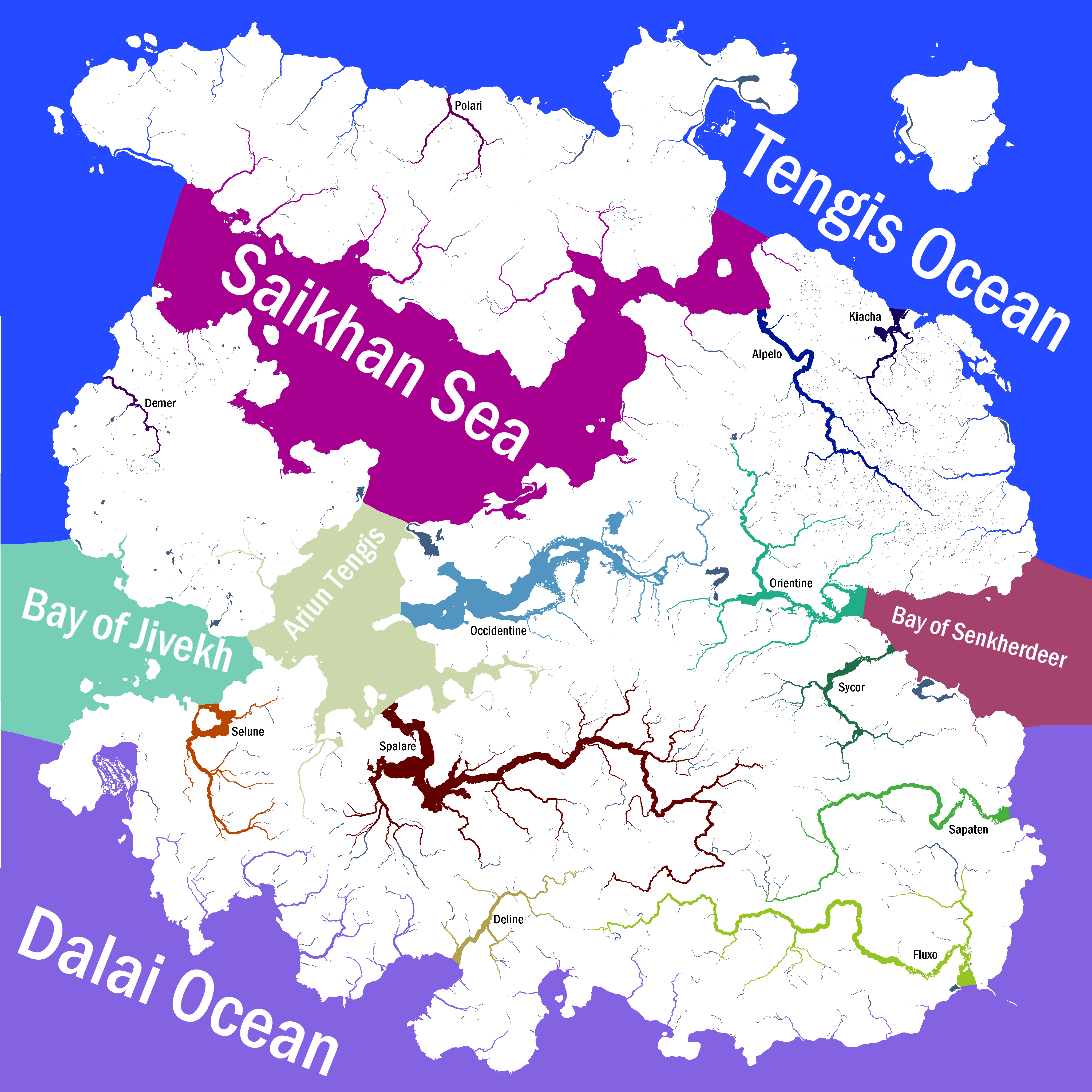
Water Bodies of Skantos


History
Primeval Era
Little is known of Skantos prior to the emergence of complex cultures and societies, with no evidence of external contact due to its position within the Skantos Maelstrom (Whose own origin is equally if not more mysterious) made it incredibly difficult to detect. The various species of Skantos, including the Skantoans, Theyvin, Omkha, and others had lived hunter-gatherer lifestyles for hundreds of millennia without leaving much of a identifiable record of the myriad of tribes and small communities they had developed, with the only records being the likes of cave paintings and the occasional relic. The earliest cultures were concentrated around central Saikhan particularly along the Occidentine River and Orientine River alongside the fertile plains to the south of said area.
Theyvin Era
Out of the various species of Skantos, the Theyvin (whom share a close common ancestor with the modern Skantoans) were the first to develop complex societies in 163100 BCE, with Theyvin spreading themselves across much of Skantos in small communities as a free people with no need to concern themselves with the possible issues that may emerge world, dedicating themselves solely to personal enrichment via changing their forms to live not only their own lives but the lives of others in an unending cycle. After countless years, the status quo was interrupted when two entities appeared onto Skantos from an aperture to another reality, revealing themselves to the Theyvin in a form much like their own and rallying those which would listen into a much more organized and disciplined force than the remaining anarchic Theyvin, ending the Primeval Era as the 'Theyvin Empire' was born in 162500 under the suzerainty of the Twin Matriarchs, whom swiftly waged a campaign to unify Skantos under one banner in a century-long struggle against dissident groups, incorporating all Theyvin they could under the Imperial System in rejection of Skantos' nature as a free spiritual world, building the planet's first structures with the pure reason of rejecting Skantos' natural order. While the Theyvin previously were free and often participated in other species' cultures on their own whims, under the guidance of the Imperial System they rejected all others as lesser.
Skantos had developex quite extensively under the reign of the Empire, with the height of their rule after the conquest of the rest of Skantos had concluded in a victory leading to largescale development of advanced technologies, with radiometric dating of unexplained structures on Umay suggesting that the Theyvin may have even ventured beyond Skantos in spacecrafts of their own design at around 95200 BCE. Despite their many successes and advancements, disagreements among the Matriarchs and the rejection of Skantos' natural state lead to the gradual decline culminating in an outright schism between the Matriarchs, with the First whom had come to appreciate Skantos wishing to cease rejecting Skantos' natural state in order to benefit the lives of the Empire's subjects to a position of equality and prosperity, while the Second wished to continue 'imperialization' to bring Skantos and the Empire into a new age of expansion under one System to dominate all. In the ensuing chaos, the empire was torn apart as the Theyvin populace suffered heavy casualties with the few survivors returning to a tribal way of life either attempting to rekindle their previous free lifestyle or yearned of a return to the System's order in perpetuity. In the chaos, the Second had been wounded and banished by the First into stasis at the cost of grave injury they could not survive from, thus wounded and alone they passed on some of their power onto a Skantoan, granting them immortality and untempered connection to a sphere of information.
Dark Ages
Early Skantoans
The Dark Ages would come to an end as Skantoans
Rise of the Paramount Nations
Interregnum
wip big volcanoe
The history of Skantos is shrouded in mystery, though despite this it is known that complex societies and settlements created by the Skantoans had begun first forming on the planet in 26500 BCE (though evidence suggests they were preceded by the Theyvin in 163100 BCE), later being joined by the Omkha in 11900 BCE. Some evidence of societies advancing enough to even achieve space travel have been found from this ancient era (primarily around Sycoryo), though clearly any such technologies were either abandoned or the societies which used them collapsed. Skantos was seemingly never colonized or discovered by any spacefaring society until 202 CE due to the Skantos Maelstrom making the planet very difficult to detect, with this eventual discovery being done by a collection of pre-unification Yatan and Theian states such as Asophania[2], Gensokyo, Iujadogia, Macanaland, though some contact had been occurring on beforehand thru the Library of Eden.
While none of the aforementioned polities ever made a very significant presence near the planet, the Commonwealth of Independent Systems is another story as the CIS has over-time established an extensive presence throughout the Skantos System in the form of various hidden facilities and space-stations making use of the Skantos Maelstrom as a easy method of hiding their presence if ever necessary, effectively turning Skantos into an informal protectorate of the CIS and Yatan-Theian Accord as a whole (despite Skantos being unaware of this status, as its inhabitants have never made contact with either of them). Skantos remained largely divided until the rise of the Ikhtalnol from the southwest and the Uhaten in the north, unifying most of the planet before their conflicts against one another and the wars caused by the aftermath of said events lead to Skantos re-fracturing. Despite their considerable presence, neither the CIS or Accord have interfered extensively on the planet aside from bombing the Uhateni Qu with nuclear weapons to prevent their expansion, causing significant damage which prompted most Skantoan societies to briefly confederate under a 'Sacred Union' until the damage subsided, allowing this 'union' to devolve into a mere alliance for mutual cooperation.
Modern Skantos
Government and Politics

The Sacred Union of Skantos is an intergovernmental association encompassing the four paramount nations of Skantos (which nominally administer a vast majority of the planet) that functions as a loose alliance intended to maintain peace and balance on the planet. The Sacred Union originates from the 'Sacred Union of Saikhan', a polity limited to solely Saikhan which emerged after the Great Skantoan Revolt, waging several conflicts against the increasingly aggressive Uhaten until the War of the Triple Alliance saw the Uhaten (and much of Skantos as a whole) destroyed, prompting them to unify with the other polities on the planet in order to prevent further conflicts between species. The Sacred Union has a fairly complex administrative structure with the sovereign 'Member-States' at the top, which preside over regional governments and communities. Annual meetings are held in the city of Lianguoshi where all willing member-states alongside representatives from their highest administrative divisions (who in the Sacred Union are referred to as 'Jasaghs') collectively organize the whole Sacred Union as a whole when necessary, or to simply foster collaboration between proximate groups. Gradually, the Sacred Union's influence has begun to weaken.
Government Structure
Administratively, the Sacred Union is incredibly decentralized with the member-states having complete independence and sovereignty within their own realms, though their territories are often fairly decentralised between various self-governing administrative divisions under local rulers. Uniquely, the Sacred Union grants all religious and spiritual traditions the same significance in government due to them being seen as parts of a 'greater whole'.
As may be expected from such a decentralized entity, the Sacred Union's 'executive government' is generally only ceremonial in order to deal with diplomacy, organizing local rulers, and managing territories with more direct loyalty to themselves. The executive is headed by the four Heads of State and Government that make up the union and thus share executive duties, with each of them representing each of the four major Skantoan cultural groups including the chief of (western) Senkher, the king/queen of Saikhan, the king/queen of Karakoram. and the abbot of Mosonaral, as while it may be theoretically possible for other individuals to be elected for this role, it is generally tradition for each of these individuals to be appointed. The leaders only have limited powers, and no means to enforce most of them outside of their own territories aside from moderating the Spiritual Diet which elects them (for life or until resignation), managing religious/spiritual affairs, and commanding the Sacred Union's military forces known as the 'Armed Banners', though this military often isn't the most effective due to being largely militia-based with only limited numbers of career-trained soldiers and sailors.
The 'Spiritual Diet' serves as the legislature of the Sacred Union, hosting annual week-long gatherings of local rulers in Lianguoshi so that they may discuss issues that affect larger regions or even the whole Sacred Union, making collaboration not only encouraged to keep the Union together but actively beneficial for all within its bounds. Additional duties of the Spiritual Diet is appointing the leaders, suggesting 'directives' for the Executive to accomplish, and appointing Yarguchi (judges) to the Supreme Yarguchi Court in Lianguoshi.
The 'Yarguchi Courts' serve as the judiciary of the Sacred Union, with each region appointing their own 'Yarguchi' (Judge) to oversee their own local courts responsible for enforcing laws within their own territories, while especially high-profile court cases are handled by the 'Supreme Yarguchi Court' in Lianguoshi.
Members of the Sacred Union
The most notable of the Sacred Union's constituents are the 'Member Nations', consisting of various independent nations which comprise a significant portion of the Sacred Union's governance, presiding over various local communities (Banners) and regions (Leagues) which remain at least nominally loyal to their presiding ruler, though some may still exist beyond the Union. Four of these member-states, Karakoram, Mosonaral, Saikhan, and Senkher, represent the four major Skantoan cultural groups (With some exceptions), while the fifth member-state of Lianguo acts as a intercultural union that serves as the capital of the Sacred Union. Beyond the members of the Sacred Union, Skantos is home to a number of additional sovereign states.
| Flag | Name | Full Title | Government Type | Capital | Official Languages |
|---|---|---|---|---|---|
 |
Karakoram | Empire of Karakoram | Absolute Monarchy | Ongansen City | Karakorumu-go |
 |
Lianguo | Republic of Lianguo | Republic | Lianguoshi | Xitangese Creole |
 |
Mosonaral | Monastic Collective of Mosonaral | Anarchic Confederacy | Byangrong Tsho (De Facto) | Mosonaralesi Skad |
 |
Saikhan | Kingdom of Great Saikhan | Semi-Constitutional Monarchy | Baixinsai | Proper Baxinese |
 |
Senkher | Senkheri Confederacy | Tribal Monarchy | Agnaqiul Sitikkut | Senkherip Kitaani |
- ↑ Alongside Memoria and especially Divine Energy, though they are less measurable.
- ↑ (which is theorised to have some connection to the previously mentioned 'space travel' discoveries)
